Locations:





Learn about 5 common triggers, treatments & risk factors
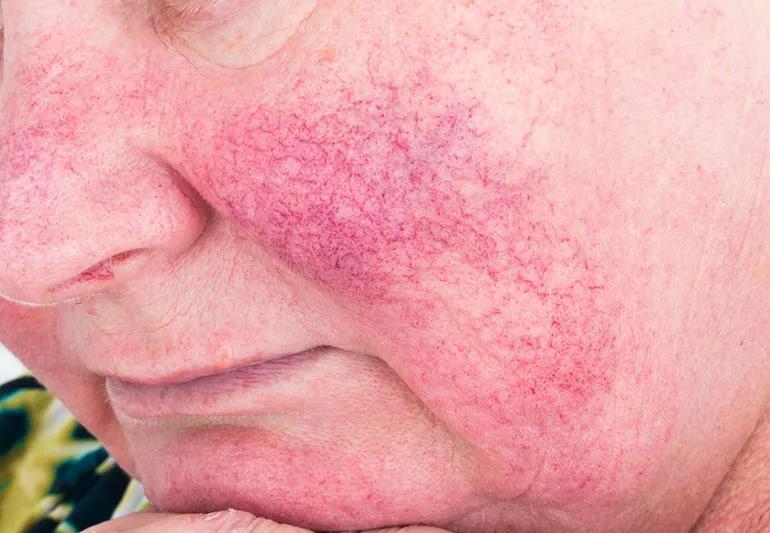
Image content: This image is available to view online.
View image online (https://assets.clevelandclinic.org/transform/e4054e0d-a1be-40ef-ab42-3ad44d9844b7/RosaceaOnFace-614739992_770x533_jpg)
Woman with rosacia on her face
If you have rosacea, you know how inexplicably your face can redden — even when you haven’t exercised or spent any time in the sun. Maybe you’ve figured out some of your triggers, like certain foods or lifestyle choices, but other times, you’re still puzzled about why your rosacea has flared up.
Advertisement
Cleveland Clinic is a non-profit academic medical center. Advertising on our site helps support our mission. We do not endorse non-Cleveland Clinic products or services. Policy
Experts don’t have a clear understanding of exactly what causes this chronic skin condition, but they do know that it runs in families.
“A number of things commonly act as triggers for rosacea flare-ups and not everyone has the same triggers. But if an individual or physician can determine specific triggers, that person may have an easier time controlling rosacea symptoms,” explains dermatologist John Anthony, MD.
He says five of the most common triggers include:
Advertisement
Dermatologist-prescribed medications that you apply directly to the skin, called topical treatments, that can help control rosacea symptoms and progression. Your physician may recommend an over-the-counter emollient cream to help repair the skin. For some forms of rosacea, you may need a topical or oral antibiotic to help control blemishes that occur during flare-ups.
“Treatments for rosacea include topical brimonidine, which helps control the redness of rosacea, and topical ivermectin, which helps with the papules and pustules that occur with some forms of rosacea,” says Dr. Anthony. These can complement many of the previously available treatments, when necessary.
He says that sulfur is a natural agent used effectively for many years as a home remedy for rosacea. You can purchase soaps and lotions containing sulfur in over-the-counter formulations at most pharmacies.
Dermatologists can remove thickening skin of the nose and flushing areas of the face using dermabrasion or electrocautery.
When discussing your rosacea with you, dermatologists ask how much the condition bothers you. Some patients don’t mind fairly extensive redness and pustules, while these symptoms affect others profoundly. “I tailor treatment to address the individual concerns of the patient,” says Dr. Anthony.
According to Dr. Anthony, rosacea most commonly appears on the face, but people can also experience symptoms on the neck, chest, scalp and ears. “When a person notices symptoms appearing in these other areas, it should prompt further evaluation by a medical professional,” he says.
Even less commonly, a form of rosacea called ocular rosacea can affect the eyes. Dr. Anthony considers this type more severe, warranting more aggressive treatment.
Talk to your doctor if you have frequent, unexplained flushing and prolonged redness in the facial area. A dermatologist can evaluate your condition, identify triggers and prescribe treatments to alleviate symptoms and prevent progression.
“The condition most commonly begins with frequent flushing of the facial skin and can progress, eventually causing the skin to appear red all the time,” says Dr. Anthony. Without treatment, you may begin to see a web of tiny blood vessels appear in the center of your face, usually the nose.
People with rosacea also may have thickening of the skin and frequent breakouts that are not due to acne.
Advertisement

Delivered every Tuesday!
Sign up for our Health Essentials emails for expert guidance on nutrition, fitness, sleep, skin care and more
Every two weeks once
Sign up for our Health Essentials emails for expert guidance on nutrition, fitness, sleep, skin care and more.
Learn more about our editorial process.
Advertisement

An enzyme deficiency or rosacea may be behind the facial flush
It’s like a protective armor that keeps your skin healthy

Medicines for depression are often misunderstood

Most recommended precautions center around minimizing bruising or swelling


Even one drink can have an impact on your cognitive function leading to slurred speech, blurred vision and impaired memory


Understand who may (and may not) benefit

This edible insect powder can be a good source of protein, fiber and other nutrients

Planning ahead, checking in with your care team and being vigilant about blood sugar monitoring can help ensure a safe fast
 Search